or Call Us 1 (888) 620-6742

Monthly Archives: February 2012

Why the tech industry is making many landowners wealthy

By: Mark Podolsky | February 22, 2012

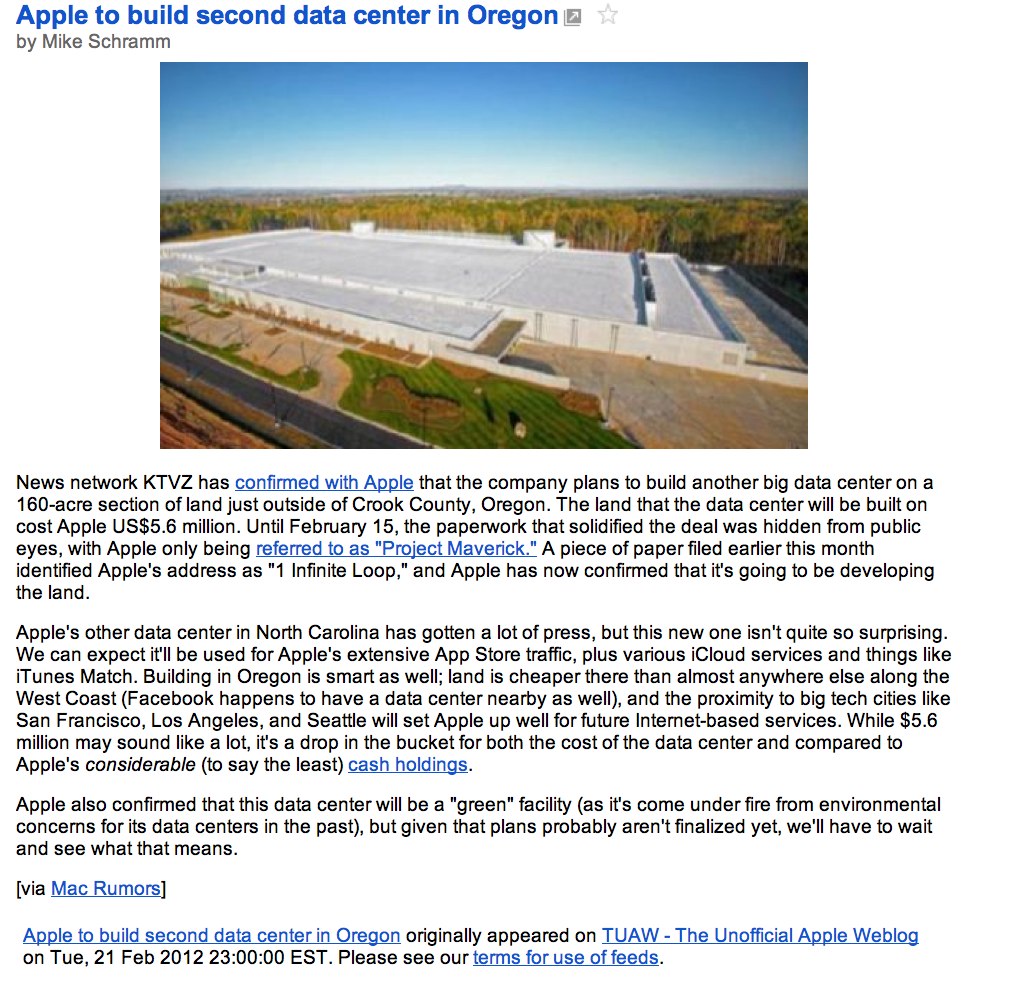
If you read the attached article, you can see why I’m bullish on owning rural land that some people would deem in the middle of nowhere. These inexpensive rural parcels make ideal investments for the tech community to house their data centers. Every time we do a Google search or save a document in the “cloud”  there is a computer server storing this information. As a result, these data centers are becoming larger  and more complex. However, due to their size and the fact that they’re just housing servers to tech companies they only need large cheap acreage to house these huge data centers. How would you like to have been the owner of the parcel Apple computer just bought in Crook Oregon!


My cash saving secret exposed & another reason to invest in Land

By: Mark Podolsky | February 10, 2012


I’m not a huge fan of cliché’s, but the cliché, “Cash is king” rings so true to me especially in this economy when banks are only loaning to those whom don’t even need the money!  So as a small business owner I’ve leveraged my land holdings into a barter machine!  Whether it’s for advertising, web services, haircuts or dental work I ask everyone that performs a service for me if they’d be interested in land as a long-term investment.  Invariably, they are intrigued and want to learn more.  Then, I pop out my iPhone, and start showing them beautiful pictures of my raw undeveloped, open space, clean air property.  The land is so foreign to their urban lifestyles that suddenly I see their imaginations are spinning.  I can see the inner explorer in them start to get excited about all of the possibilities of owning raw land and what they could do on it one day.  As a result, I save my cash and get what I consider a valuable service performed for me and they get to own land they never even considered was possible from their perspective.  A typical “Win-Win” barter scenario!

I just had a lengthy conversation with the CEO of a large corporation based in San Diego. The CEO has been investing in property from me for several years and has never even visited his land!   We discussed why he was buying property and I found it interesting that from his point of view the property was not just a legacy for his family’s trust,  but also a way to show the bank  he had substantial assets and could use those assets for additional collateral should his business need  financing.  He was also intrigued by the barter model although he had never attempted to barter his land or use his company’s services to acquire land.  Nevertheless, it did get him thinking about his land in a different way and how the asset could be leveraged in other creative ways.

However, here is the bad news– you have to pay taxes on the trade. Bartering does not exempt you from paying taxes, so be sure to keep track of the goods and services you barter for, and report this to the IRS.

if you have questions about how barter works there are many excellent websites and services that can help you take your raw land and barter it for other goods and services! In fact, I know of another developer friend of mine date that bartered his raw land for a new car! Check out the links below to learn more:

http://www.bartergroup.com/

http://www.tradeaway.com/

http://www.barterquest.com/


Is All Cheap Land Flawed?

By: Mark Podolsky | February 9, 2012

Land is one tricky commodity to acquire.   It’s not like buying a house where you can readily see the neighborhood comps and see what the typical house in that neighborhood sells for on a per square foot basis.  As a result, our brains when we don’t have enough information quickly filters value and quality by price.   However,  the attributes of each individual parcel of land can vary greatly not just in the area, but even in the same subdivision. For example, the soil and well depth in one area of the subdivision can be completely different from another area of the same subdivision. Thus, the property that has the higher price must have the superior attributes than another parcel in the same area or so our thinking would go.  

As an example, I just spoke with a seller today about her 20 acres of land in Lassen County  California. She was listing her property for $14,000 even though her neighbor was selling their property for $69,000. I asked her why would her land be so much less expensive than the adjoining parcel? She said the adjoining parcel had power, and a well. Power and water  already on the land makes it much more valuable than undeveloped acreage!  Yet, without digging deeper it was difficult for me to assess if the $14,000 for 20 acres was reasonably priced, a screaming deal or a big mistake.  

My next call was to the County assessor.  I wanted to find out the last 5 comparable sales in that area. That would at least give me a better idea of the price even though it was impossible for me to determine if the other properties were improved with power and water or unimproved. Nevertheless, I always find getting a price range in an area helpful.   Unfortunately, the prices were so random that it was impossible for me to see any type of pattern in that area. Plus, there weren’t enough sales in that Township Section and Range to know if this was a comparable sale or not.   Therefore,  my next call was to the local water drilling company.  The driller stated that it would cost $48 drilled and cased per foot and $800 for a 20 foot sanitary well seal and then $146 for the County water well permit.  So on average he said that in this area he would have to drill about 100-150 feet.  So the total cost would be about $5600 for a 100 foot well that would pump 15-20 gallons per minute which is really good.    I then figured if I went the solar route in this area it would cost about $10k-$12k for power.

Now I had my rough numbers.   I figured $14,000 for the land plus $7500 for a well just to be conservative,  then another $12,000 for my solar power solution. So the total price to have a comparable piece of property to my potential neighbor would have been $33,500.  Based on my rough numbers and the fact I had $34,500 in potential profit to play with, it would be worthwhile to continue investigating this property.  

Obviously, as I’ve discussed before, the property would have to be compelling to me and hopefully another buyer/investor. If I had simply looked at the $14,000 price for 20 acres and listened to my gut which immediately said, “This seems too cheap to be any good”  I may have missed out on an unbelievable opportunity. Perhaps the seller was desperate? Or, they inherited the property and had no idea what the value of the property was. As always, you have to do your due diligence to determine if land that seems at first blush is really cheap is flawed or an excellent opportunity!

 If you find a piece of land that you think may be too good to be true, shoot me an e-mail and for a small consulting fee, I can help you with your due diligence and walk you through the process so the next time you locate property you won’t just dismiss cheap land as being flawed. 

Are you buying in a flood zone?

By: Mark Podolsky | February 8, 2012

Investing in raw land over the last 11 years has taught me some hard lessons. The 1st lesson, is not to trust the tax assessors database. However, I always thought that I could trust the flood designation. Unfortunately, with FEMA changing the flood designations on an annual basis this is not the case. With FEMA constantly changing the flood hazard maps, a property that may have been designated outside of a floodplain a few years ago may now actually be located within a hazardous boundary.

 So what can you do about this?  

Buying a property in a high-risk flood zone could mean additional expenses including a flood survey as well as ongoing flood insurance.  In addition to this, it could make the home more difficult to sell at some point in the future as a result of this designation (not to mention the expense and headache associated with a flooded property).  Flood insurance alone can be anywhere from a few hundred dollars a year all the way up to a few thousand a year, depending on the flood zone category. The bottom line is any property purchase should be made with full knowledge and awareness of the property’s flood zone designation.

Going forward, we have implemented a policy in my office to run official flood certifications on any new properties we put under contract. Rather than rely on our local tax database or even some of the free flood zone sites online (which we have also found to be inaccurate), we have partnered with local lenders to run this for us . We also have an insurance agent that can run flood certs as well.  Most investors have a good relationship with either an insurance agent or loan officer that would be willing to help in this area – don’t be afraid to utilize these relationships for this valuable information.

As an aside, if you do discover that a property you have purchased is in a flood plain, consider carefully what kind of flood insurance coverage you want. It may be that your lender requires flood insurance, but doesn’t necessarily dictate how much coverage you need. If this is the case and you feel confident that the property won’t flood, you may be able to elect to cover only the building (not contents), insure for a lesser dollar amount, or carry a higher deductible. In doing so, you can lessen the impact that flood insurance has on your cash flow by obtaining a policy with a smaller yearly premium.

For more information on the National Flood Insurance Program, check out the official government website at FloodSmart.gov. But even more importantly, make sure you have the ability to determine the flood zone of a property before you buy it. The last thing a real estate investor wants is a property with unexpected risk and expenses cutting into future profit.

More alternative housing ideas

By: Mark Podolsky | February 2, 2012

As solar technology improves as do other off grid technologies it becomes easier and easier to live a simpler homesteading lifestyle off the grid. In fact, check out the link below for more alternative housing ideas if you’ve ever dreamt of living on your own off the grid.  Here is the link from the survivalspot.com.  Let me know if you have a favorite off-grid form of housing I forgot to include.    http://www.survival-spot.com/survival-blog/9-unique-alternative-housing-ideas/#toc-shipping-containers

We’re Here to Help! Let’s Get Started
We really wanted to hear from you, we can guide you step by step.
get in touch now